Why 20,000mAh Power Banks Don't Really Give 20,000mAh
A 20,000mAh power bank rarely delivers the full 20,000mAh to your phone. Voltage conversion, heat, cable loss, and charging inefficiency shrink the real usable capacity, so what you get feels closer to 12,000–15,000mAh.
Know The Reasons Why 20,000mAh Power Banks Don't Deliver 20,000mAh in Real Use.
Power banks have become the modern-day equivalent of carrying an extra bottle of water in summer. You don't always need it, but the day you do, it feels like a lifesaver. And if you've ever bought a 20,000mAh power bank, you probably did it with the confidence of someone who has planned for every possible emergency. Then reality happens.
Explore important features of 20,000mAh power bank you must know before buying one; Photo Credit: Pexels
Your phone charges twice, maybe three times, and suddenly the power bank is blinking like it's tired of your expectations. You start doing mental maths, squinting at the box, wondering if you got fooled. The truth is more interesting than “fraud”. The number printed on the box is real, but it's not the number you experience.
Let's unpack why that happens, in plain language, without the boring lecture vibe.
Also Read: Ambrane, boAt To Xiaomi, Top 10 Power Banks Under ₹2000 That Keep Your Devices Charged All Day
What Really Happens Between the Box and Your Battery
The mAh Number Is Measured At a Different Voltage
This is the biggest reason, and it's also the one most people never hear about. The 20,000mAh rating is almost always measured at the battery's internal voltage, which is usually around 3.7V. Your phone, however, charges at 5V through USB, and often higher with fast charging.
So even before anything else goes wrong, you're already dealing with a conversion gap. Think of it like buying 20 litres of milk, but the shop measured it before removing the foam. Technically, the quantity is correct, but what you pour into your glass won't feel the same.
A 20,000mAh power bank at 3.7V contains roughly 74 watt-hours of energy. Once it boosts that to 5V, the usable capacity drops. It's not because the power bank is lying. It's because the measurement is done in a way that looks bigger on paper.
It's like a “maximum possible” number, not a “what you'll actually get” number.
Energy Is Lost During Voltage Conversion
Power banks don't magically deliver energy at the exact voltage your phone needs. They use internal circuits to convert the battery's voltage into the output voltage. That conversion costs energy. Always.
Even good power banks lose a noticeable chunk here. Most operate somewhere around 80% to 90% efficiency in ideal conditions. And “ideal conditions” usually mean a comfortable temperature, steady output demand, and no fast charging stress.
In real use, the efficiency often dips lower. That means a part of your precious 20,000mAh gets spent on the power bank's own work of converting power. It's not going into your phone. It's getting burned off as heat.
That warmth you feel in your hand while charging isn't just a vibe. It's lost energy. In summer, this becomes even more dramatic because higher temperatures make electronics less efficient.
So yes, you paid for energy. But some of it becomes warmth instead of battery life.
Fast Charging Makes Losses Worse
Fast charging feels like a superpower. Plug in for 20 minutes and boom, your phone jumps from 12% to 55%. It's addictive. It's also one of the reasons your power bank feels like it drains too quickly.
Fast charging pulls higher current, and sometimes higher voltage. That means the power bank's internal circuits work harder. The more they work, the more heat they produce. The more heat they produce, the more energy gets wasted.
It's like driving a scooter at 40 km/h versus 80 km/h. You'll reach faster at 80, but fuel consumption goes up and efficiency drops. Fast charging has the same personality. Speed comes with a cost.
Also, many power banks advertise 22.5W or 30W output, but sustaining those speeds drains them quicker than expected. You might get fewer total charges than you would if you charged slowly overnight.
Fast charging is convenient, but it's not “free”. Your capacity pays the price.
Cable Quality Quietly Eats Your Battery
This one is sneaky because people rarely blame the cable. They blame the power bank. But the cable often plays the villain.
A cheap cable has higher resistance. Higher resistance means more energy turns into heat while travelling from the power bank to the phone. This isn't a tiny loss either. If the cable is thin or poorly made, it can waste a surprising amount of energy.
You might have noticed this: one cable charges your phone quickly, and another feels sluggish. That's not imagination. That's physics.
Now imagine using a low-quality cable with a 20,000mAh power bank. You'll lose energy twice: once in the power bank's conversion, and again in the cable.
It's like ordering biryani for ₹250 and losing half the portion because the delivery box leaked. The restaurant did its job. Your container failed you.
A decent cable won't turn your power bank into a miracle machine, but it will stop unnecessary waste.
Your Phone's Battery Doesn't Accept Power Perfectly
Even if the power bank and cable are perfect, your phone battery isn't a flawless bucket waiting to be filled. Charging a battery involves chemical processes, and those processes are not 100% efficient.
Some energy is lost inside the phone as heat. That's why phones warm up during charging, especially during fast charging. The phone's charging circuitry, battery management system, and thermal controls all use energy.
Also, the phone's charging speed changes depending on battery percentage. It charges quickly at low levels, then slows down near 80% and slows further near 100%. That slow charging phase is less efficient. It takes longer and wastes more energy.
So when you charge from 80% to 100% using a power bank, it feels like the power bank is being dramatic. But the phone is actually sipping power in a less efficient way.
Your power bank isn't just charging a battery. It's feeding a whole system that has its own losses.
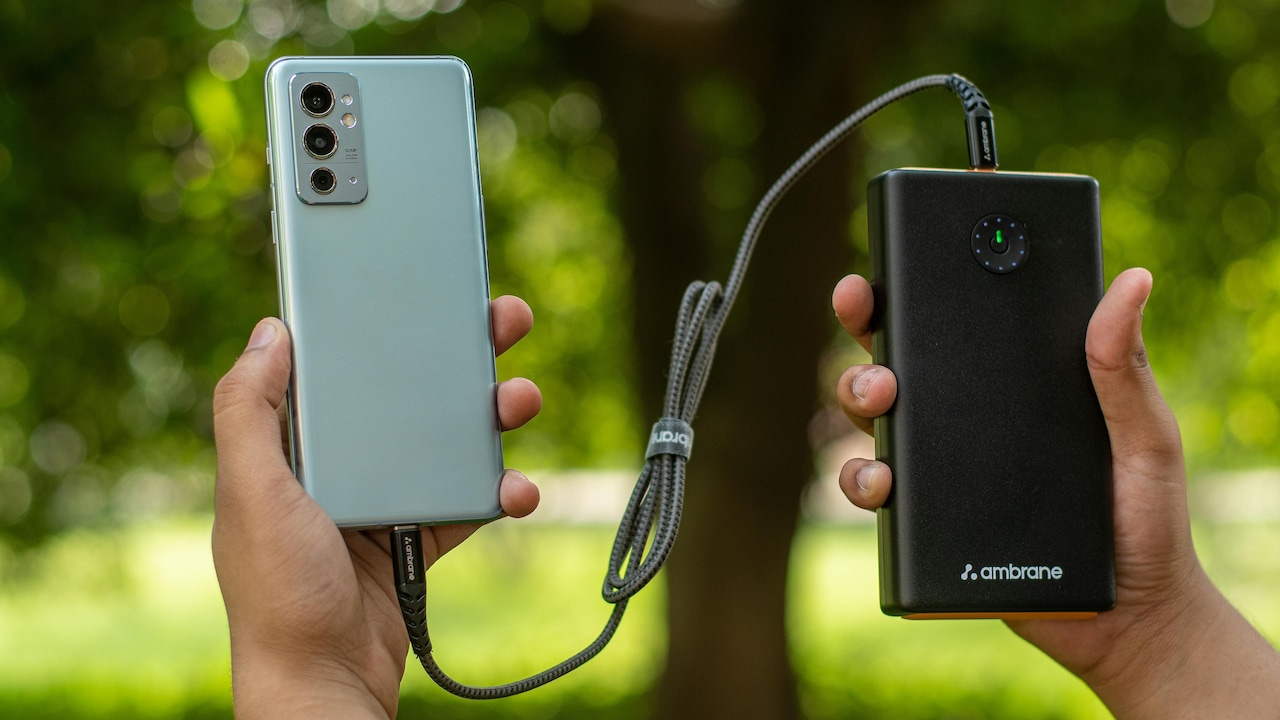
Charging phones with a power bank can cause it to overheat while in use; Photo Credit: Pexels
Real Capacity Drops Over Time
Power banks age, even if they sit quietly in a drawer like a forgotten biscuit tin. Lithium batteries degrade with time. The first few months feel great, then slowly the capacity shrinks.
After a year of regular use, many power banks won't hold the same charge they did on day one. This happens faster if you frequently drain it to 0% and charge it to 100%, or leave it in hot places like a parked car.
Heat is the silent killer. It speeds up battery ageing. And yes, summer heat can do damage even if the power bank is not being used.
So someone might buy a 20,000mAh power bank and initially get around 2.5 charges for a 5,000mAh phone. A year later, it might drop to 2 charges. Same device, same phone, but the battery inside has grown older and less capable.
Capacity ratings are usually based on fresh cells. Life, unfortunately, is not always fresh.
Many Brands Use “Nominal” Capacity for Marketing
Here's where things get a little spicy. Not all brands play fair, and some play the “technically correct” game too well.
The printed capacity is often the nominal capacity of the internal cells. That's a lab-based number measured under controlled conditions. Real-world output capacity, the one that matters to you, is often lower and rarely printed in bold.
Some honest brands mention something like “rated capacity” or “typical output capacity” in smaller text. Others don't bother. They let the big number do the selling.
So you buy a 20,000mAh power bank expecting a heroic performance, but what you get is the real-world output, which might be closer to 12,000mAh to 14,000mAh, depending on efficiency.
That gap isn't always a scam. But it is absolutely marketing theatre.
It's like ordering a “family pack” of chips and opening it to find mostly air. The weight is correct, but your heart still feels betrayed.
Multiple Ports Split Power and Reduce Efficiency
Power banks love bragging about ports. Two USB-A ports, a USB-C port, maybe even a micro-USB input for nostalgia. It looks like a Swiss Army knife.
But when you charge multiple devices at once, things change.
The power bank has to distribute power between devices. The internal circuitry works harder. Heat increases. Efficiency drops. The output may also throttle to protect the system, especially in budget models.
Charging two phones together feels productive, like you're managing life like a pro. But the power bank often drains faster than expected, and both phones may charge more slowly.
This isn't because the power bank is weak. It's because it has limits, and splitting power introduces more conversion losses. It's like trying to share one plate of pani puri between two people. Everyone gets some, but nobody feels fully satisfied.
If you want maximum capacity from your power bank, charging one device at a time usually gives better results.
Temperature Changes Everything
Power banks hate extreme temperatures. And unfortunately, the weather loves extremes.
In hot conditions, efficiency drops and batteries degrade faster. In cold conditions, battery chemistry slows down and output performance drops. Either way, you lose.
If you've ever tried using a power bank outdoors during peak summer or on a chilly early morning trip, you might have noticed weird behaviour: slow charging, sudden percentage drops, or the power bank getting warm too quickly.
Temperature also affects your phone. A warm phone may slow charging to protect itself. A hot power bank may reduce output to avoid overheating. Both devices start acting cautiously, like elders telling you not to overwork.
So even if you have a good 20,000mAh power bank, using it in harsh conditions will make it feel smaller. Not because the rating is fake, but because the environment is actively sabotaging the experience.
Batteries are moody. Weather makes them moodier.
Your Phone Uses Power While Charging
This is the most human reason of all: people rarely charge a phone and leave it alone.
Most people charge while doing something. Watching reels, using maps, playing games, taking calls, scrolling through shopping apps, replying to messages. And all that activity consumes power.
So the power bank isn't only filling your phone battery. It's also running your phone at the same time.
This is why charging feels slower when you're using the phone. It's also why your power bank seems to drain quickly. A chunk of the power is going into the screen, the processor, mobile data, and background apps.
Navigation apps are especially hungry. If you're travelling and using maps on full brightness, the power bank is fighting a losing battle. It's like pouring water into a bucket with a small hole.
The phone might show “charging”, but the net gain is smaller than expected. And the power bank takes the blame.
If you want to stretch your power bank, reduce screen brightness, close heavy apps, and avoid gaming while charging. Your future self at 2% battery will thank you.
Products Related To This Article
1. URBN 20000 mAh Premium Edition Nano Power Bank
2. Portronics Luxcell Mini 20K Advanced 20000 mAh Nano Power Bank with 22.5W Max Output
3. Amazon Basics 20000 mAh Power Bank
4. Xiaomi Power Bank 4i 20000mAh 33W Super Fast Charging PD
5. Portronics Luxcell Mini 20K Advanced 20000 mAh Nano Power Bank with 22.5W Max Output
A 20,000mAh power bank doesn't fail because it's useless. It “fails” because the number on the box isn't the number you experience. The rating is measured at the internal battery voltage, not at the output. Add conversion losses, fast charging heat, cable quality, phone inefficiencies, ageing, temperature, and real-world usage habits, and suddenly the maths starts making sense.
The real takeaway is simple: a 20,000mAh power bank is still a solid purchase, but expectations need a small reality check. In practical terms, it usually delivers around 12,000mAh to 15,000mAh of usable output, sometimes more if conditions are ideal and sometimes less if life is chaotic.
So the next time your power bank feels like it's underperforming, don't assume you got cheated. You might just be seeing the messy, honest truth of electronics in the real world. And honestly, that's still better than being stuck with 1% battery and a dead socket at a crowded station.
(Disclaimer: This article may include references to or features of products and services made available through affiliate marketing campaigns. NDTV Convergence Limited (“NDTV”) strives to maintain editorial independence while participating in such campaigns. NDTV does not assume responsibility for the performance or claims of any featured products or services.)