When Household Chores Become The New Love Language: Inside Flipkart's New 'Choreplay' Campaign
Flipkart's new Valentine's Day special 'Choreplay' campaign spotlights how shared household chores strengthen modern relationships and why equal participation sparks attraction.

Flipkarts Choreplay campaign reframes domestic chores as acts of modern intimacy and shared partnership.
For generations, romance has worn many familiar faces. Bouquets carefully chosen at the florist's counter, handwritten notes slipped into lunchboxes, the quiet intimacy of a shared cup of tea at the end of a long day. But in modern Indian households, especially among millennial and Gen Z couples, affection has found a new, surprising expression: the simple, everyday act of doing the chores.
At its heart, ‘Choreplay' celebrates equality at home, not as duty, but as a new language of love.
Photo Credit: Flipkart
Flipkart's latest Valentine's Day campaign, 'Choreplay', leans into this cultural shift with a blend of humour, subtle sensuality, and a sharper truth about relationships today. In doing so, it makes a point that feels both modern and overdue: for many women, desire is sparked not by grand gestures, but by a partner who participates in the domestic world with intention, care, and competence.
And, as it turns out, the statistics agree. According to the campaign, one in two women feel more attracted to their partners when they see them doing household chores. In an era where conversations around equal partnerships have gained momentum, this insight is not only relevant, it's resonant.
Also Read: Refrigerator Cooling Problems: Why Fridge Shelves Have Uneven Temperature
A Cheeky Film With A Clear Message
The centrepiece of the campaign is a delightfully crafted video featuring a boyfriend going about everyday household tasks like washing dishes, mopping floors, ironing clothes, while his girlfriend narrates the scene. There is, however, a curious twist. Every time he performs a chore, the very word for it is censored. When he washes dishes, "dishes" becomes an audible beep. When he mops, "mopping" is beeped. "Cleaning," "cooking," "ironing," "sewing", one by one, they all fall under the mysterious censorship.
Meanwhile, his hands. busy with soap, mop, or fabric, are blurred out as if he were engaged in something scandalous.
Confused and increasingly exasperated, the boyfriend finally asks the obvious question: “Why is this being censored? I'm simply doing the chores.”
The girlfriend's response lands with the kind of playful honesty that gives the film its charm: “When you keep the house in order, I go out of order.”
It is flirtatious without being crude, humorous without losing warmth. The film strikes a delicate balance, suggestive enough to feel like Valentine's Day, yet tasteful enough to remain family-friendly. Most importantly, it captures a truth couples often joke about but seldom articulate: responsibility is attractive. And mutual contribution in a home is not just duty, it is partnership, intimacy, and, yes, even chemistry.
The Cultural Moment Behind The Campaign
What makes 'Choreplay' more than just a playful Valentine's gimmick is its relevance to a much larger cultural conversation.
Across India, domestic roles are shifting. Many urban women juggle demanding careers while also carrying the disproportionate share of household responsibilities. Studies repeatedly show the emotional and logistical load still falls largely on women, even in dual-income households. In this context, a partner who steps in to share the work is not merely "helping." He is acknowledging her time, her energy, and her humanity.
In other words, equality itself becomes romantic.
Flipkart's campaign mirrors this shift with a wink rather than a lecture. By framing chores as something simultaneously ordinary and unexpectedly appealing, the brand taps into the evolving language of modern relationships, and does so in a way that sparks both recognition and amusement.
Introducing The Choreplay Store: Where Domesticity Meets Desire
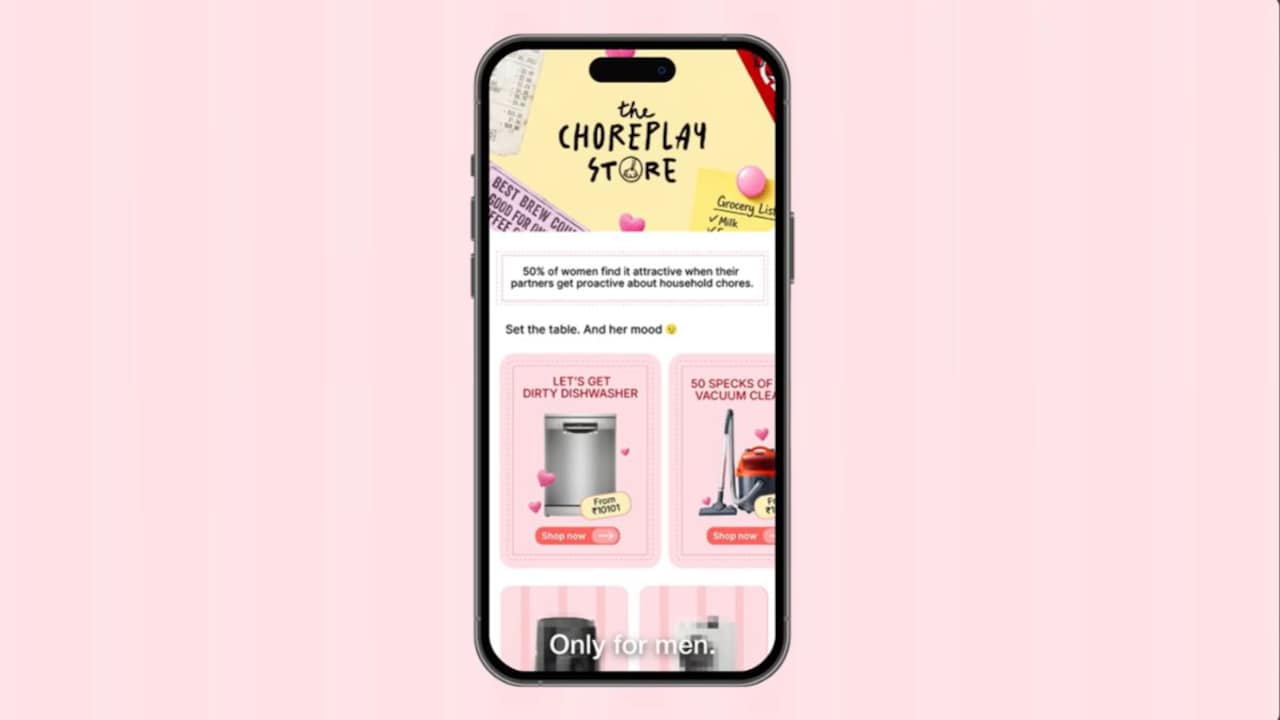
The film leads viewers to the newly launched Choreplay Store on Flipkart, a curated selection of home appliances positioned with an irreverent, Valentine's-ready spin. Each item is introduced with playful descriptions that transform everyday tasks into gestures of affection, giving familiar chores an entirely new sheen.
A glimpse into the line-up:
1. ‘Let's Get Dirty' Dishwasher
To clean is to care, and this one begins with the basics. The dishwasher is framed as the first step to “getting things messy later by getting things clean now,” subtly linking tidiness with tenderness.
2. ‘Manhandle With Care' Floor Wiper
There is something inherently rhythmic about mopping, and the copy leans gently into this idea. The motion is described as “back and forth” in a way that feels both cheeky and charmingly relatable.
3. ‘Get Soaked' Washing Machine
Here, the machine becomes an instrument of intimacy. As the campaign suggests, whispering “gentle cycle” may earn a smile, and perhaps a little more.
4. ‘Filling So Sexy' Storage Containers
Organisation becomes an attractive trait, conveying dependability and control. “Line them up, sort them out,” the description encourages, turning tidiness into a virtue that commands admiration.
5. ‘50 Specks of Grey' Vacuum Cleaner
A clever twist on a familiar title, this one promises deep, comprehensive cleaning, every corner, every crevice, echoing a partner who doesn't shy away from effort.
6. ‘3-Way Fun' OTG (Oven Toaster Grill)
This appliance celebrates timing, precision, and care, qualities as important in the kitchen as they are in relationships. “Push the right buttons, wait for the right sounds,” the copy says, with just enough mischief to raise an eyebrow.
It is this blend of lightly suggestive humour and practical utility that defines the Choreplay Store. It invites couples to see their homes not as battlegrounds of responsibility, but as shared spaces where effort translates to affection.
Why This Approach Works
What stands out about Flipkart's campaign is that it does not romanticise domestic labour. Instead, it reframes it. By presenting everyday chores in a flirtatious light, it highlights an essential truth: the emotional impact of shared responsibility is far greater than the sum of swept floors or folded clothes.
Chores are not merely mechanical actions. They are gestures, of partnership, respect, and attentiveness. When one partner steps in, the other feels supported, cared for, and valued. That sensation, when viewed through the lens of a relationship, becomes undeniably attractive.
In this sense, Flipkart's campaign does more than market appliances. It taps into a social insight with humour and flair: that intimacy in modern relationships often begins not with candlelight, but with consideration.
A Valentine's Day Message With Meaning
Valentine's Day campaigns often lean heavily into cliches, roses, chocolates, candlelit dinners. Flipkart takes a different path, offering a refreshing perspective that speaks to the realities of contemporary Indian couples. It is clever without being frivolous, cheeky without losing charm, and rooted in cultural truth without becoming preachy.
By transforming the domestic sphere into a stage for romance, the ‘Choreplay' campaign encourages couples to rethink what love looks like in everyday life. And perhaps, in doing so, it offers a gentle reminder: sometimes the most meaningful gestures are not whispered sweet nothings, but the simple act of picking up a cloth and wiping down the kitchen counter, without being asked.
This Valentine's Day, Flipkart invites couples to bring a touch of playfulness into their homes, to celebrate partnership in all its forms, and to discover that the path to the heart may, indeed, pass through the dishwasher.
Frequently Asked Questions (FAQs)
1. Why is men's participation in household chores important today?
Because modern relationships thrive on shared responsibility. When men contribute equally at home, it reduces the emotional load on women and strengthens partnership, trust, and overall harmony.
2. Does research show that women find men more attractive when they do chores?
Yes. Several reports indicate that shared domestic work boosts relationship satisfaction, and Flipkart highlights this with the insight that one in two women feel more attracted to partners who handle household tasks.
3. How does equal division of chores impact modern Indian couples?
It leads to better communication, lower stress, and a more balanced home environment, especially in dual-income households where both partners juggle work and domestic duties.
4. Are men participating more in household responsibilities today?
Urban Indian households are seeing a clear shift. Younger couples increasingly divide chores more fairly, reflecting evolving gender expectations and a more egalitarian mindset.
5. How can couples encourage fairer distribution of chores?
By communicating clearly, sharing responsibilities based on strengths and schedules, using appliances that simplify tasks, and seeing household work as teamwork rather than gendered duty.
(Disclaimer: This article may include references to or features of products and services made available through affiliate marketing campaigns. NDTV Convergence Limited (“NDTV”) strives to maintain editorial independence while participating in such campaigns. NDTV does not assume responsibility for the performance or claims of any featured products or services.)