How To Choose A Mirror Size That Actually Works For Your Space
Use simple ratios and easy measuring tricks to pick a mirror that fits your wall, furniture and daily use, without making the room feel awkward or cramped.

Mirror Size Tips: Here Are The Best Mirror Dimensions For Living Rooms, Bedrooms And Bathrooms.
Mirrors do more than show a good hair day. They bounce light, stretch sightlines, and add a stylish pause to a wall that feels empty. Still, mirror shopping often turns messy. A mirror looks perfect in a showroom, then at home it feels tiny, huge, or oddly 'floaty' on the wall. That's not bad taste. That's sizing.
Mirror sizing works like good tailoring. The right fit flatters the room. The wrong fit distracts, even if the frame costs ₹18,000 and arrives in fancy packaging. The secret sits in proportions. A mirror should relate to the furniture under it, the wall around it, and the way people move through the space.
Here is how to choose a mirror size that actually works for your space - living rooms, bedrooms and bathrooms. This article turns sizing into 10 straightforward checkpoints.

Mirror Size Tips
Photo Credit: Pexels
The 10 Mirror-Size Rules That Never Fail
1) Start with the wall, not the mirror
A mirror should suit the wall like a well-cut kurta suits the body. Begin by treating the wall as the 'frame' for the mirror. Measure the wall's usable width and height. Ignore skirting, switches, and that one stubborn nail nobody admits to placing. Then decide how much breathing space the mirror needs around it. A good baseline: leave 10–20 cm of clear space on each side for smaller walls, and 20–30 cm for broader ones.
This spacing prevents the mirror from looking squeezed or lost. It also keeps the wall from feeling like a puzzle with pieces touching. On a narrow wall near a doorway, a slim vertical mirror often fits better than a wide one. On a big living-room wall, a tiny mirror can look like a postage stamp. A simple check helps: stand back and squint. If the mirror reads as a 'dot', go bigger.
2) Match the mirror to the furniture beneath it
Mirrors love company. Most of the time, that company comes as a console, dresser, sideboard, or vanity. The mirror should relate to that piece, not fight it. A reliable rule: choose a mirror that measures around two-thirds to three-quarters the width of the furniture below. So if a console spans 120 cm, aim for a mirror between 80 and 90 cm wide.
This ratio creates balance. It stops the mirror from hovering awkwardly. It also avoids the 'top-heavy' look that happens when a mirror stretches wider than the table beneath it. In a bedroom, a mirror above a dresser should not exceed the dresser width. In a dining area, a mirror above a sideboard should echo the sideboard's proportions, especially if crockery or artwork sits nearby.
A quick real-world tip: tape a rectangle on the wall using masking tape in your target size. Live with it for a day. If it feels calm, that size works.
3) Use eye level as the anchor, not the ceiling
Many people hang mirrors too high because the ceiling feels like the 'top'. Rooms don't work that way. People do. Aim to place the mirror so the centre sits near eye level for most adults, roughly 145–155 cm from the floor in many homes. This placement makes the mirror feel natural. It also reduces awkward reflections of ceiling fans and tube lights.
In an entryway, this rule matters even more. Guests should not need a neck stretch to check their hair. In a bathroom, adjust slightly depending on who uses the sink most. If children share the space, a slightly lower mirror can reduce daily complaints.
Height also affects perceived size. A mirror hung too high can look smaller because the wall swallows it. Hang it at the right height, and it suddenly feels bigger, even if the size stays the same. That's the cheapest 'upgrade' available.
Also Read: Top 5 Mirrors Under ₹1,100 That Create an Illusion of Roominess, Making Your Home Feel Larger
4) Pick a shape that suits the room's lines
Size doesn't live alone. Shape changes how size feels. A tall, narrow mirror can make a low ceiling feel higher. A wide mirror can stretch a compact room. Round mirrors soften sharp corners and busy patterns. Rectangular mirrors add structure and suit modern, clean lines.
In a living room with a long sofa, a wide rectangular mirror can echo the sofa's horizontal line. In a tight foyer, a tall mirror can lengthen the space and create a 'walkway runway' moment. In a bedroom with many straight edges, bed, wardrobe, side tables, a round mirror can act like a visual exhale.
When in doubt, look at what dominates the room. If the room has many vertical elements, a horizontal mirror can balance them. If the room feels low and wide, a vertical mirror can lift it. Shape won't fix the wrong size, but it can make a good size feel perfect.
5) Decide the mirror's job: light, depth, or checking outfits
A mirror's purpose should decide its size. A 'feature mirror' needs presence. An 'outfit mirror' needs height. A 'light booster' needs placement opposite a light source. Without a clear job, mirror sizing turns into guesswork and regret.
For outfit checking, aim for at least 150 cm in height for a full-length view. A width of 40–60 cm suits most spaces. For a feature mirror above a sofa, the mirror should read clearly from across the room. That usually means 90–120 cm wide, depending on wall size and furniture below. For light boosting in a dim corridor, a medium mirror placed opposite a window can work better than a huge mirror placed randomly.
Think of the mirror as a staff member. Give it one responsibility. It will perform better. Also, the room will look more intentional, which always feels expensive, even when the mirror costs ₹2,500.
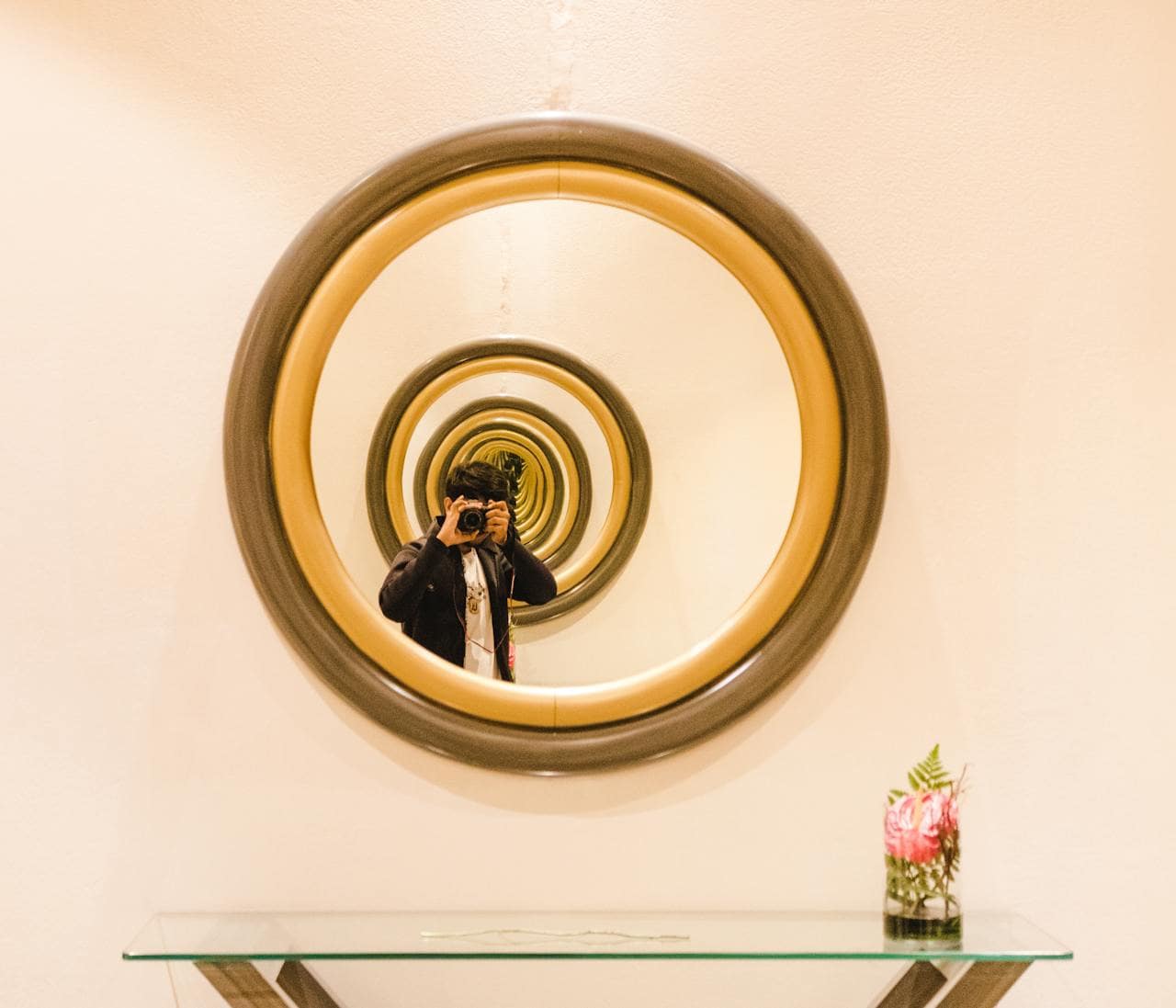
Mirror Size Tips
Photo Credit: Pexels
6) Full-length mirrors: the 'floor rule' and the 'step-back rule'
Full-length mirrors trigger the most sizing confusion. People buy a tall mirror, then tuck it behind a chair. The mirror sulks. Use two rules to avoid that.
First, the floor rule: a full-length mirror looks best when it sits close to the floor. If it hangs, keep the bottom edge around 15–25 cm above the floor. If it leans, let it touch the floor or sit within a few centimetres. That grounding makes it feel intentional.
Second, the step-back rule: allow enough space to step back at least one pace. Without that space, the reflection feels cramped, and the mirror seems smaller than it is. In a bedroom where the bed eats most of the floor area, a wardrobe door mirror might work better than a freestanding one.
A gentle reality check: a 180 cm mirror in a 90 cm-wide gap can feel like a giant stuck in traffic. Choose proportion, not bravado.
7) Bathroom mirrors: width beats height more often than expected
Bathrooms push people towards tall mirrors, but width often matters more. The mirror should align with the sink or vanity. For a single sink, choose a mirror that matches the vanity width or runs slightly smaller, around 70–90% of the vanity width. For a double sink, a wide mirror that spans both sinks can look sleek and reduce visual clutter.
Height depends on who uses the space, but most bathrooms don't need a mirror taller than 75–90 cm unless the wall design calls for drama. Too tall and the mirror starts reflecting things nobody wants to admire, like exposed pipes or a towel that gave up.
Also consider lighting. A mirror that sits too close to a light fixture can create glare. Leave a little 'air' above the mirror if a wall light sits higher. If the only light comes from above, a wider mirror can spread that glow more evenly.
Also Read: How To Choose The Perfect Wall Mirror: Designer Tips On Style And Placement
8) Make small rooms feel bigger without going oversized
Small rooms love mirrors, but size choices still need discipline. A common mistake: buying a massive mirror for a tiny room and hoping it turns into a palace. That can backfire. The mirror can dominate the wall and make the room feel crowded.
Instead, aim for a mirror that expands the view without swallowing the wall. In a compact living area, a medium-to-large mirror placed opposite a window can double the sense of light. In a narrow hallway, a series of smaller mirrors can create rhythm and depth, like a gallery that also checks your lipstick. In a small bedroom, a tall mirror near the wardrobe can extend sightlines without blocking movement.
A playful trick: stand where you want the mirror, then look at what it will reflect. If it reflects clutter, the mirror will double the chaos. If it reflects light or a calm corner, it will double the charm.
9) Use a simple measuring method that saves money and patchwork
Mirror sizing feels emotional because returns feel painful. Avoid the 'buy and cry' cycle with a simple three-step method.
Step one: measure the target wall area and note the furniture width below, if any. Step two: mark the mirror's outline with masking tape on the wall. Step three: live with the taped outline through one full day, morning light, evening light, and normal movement.
This method shows problems early. A taped outline can reveal that a mirror blocks a switchboard, crowds a door swing, or sits too high for daily use. It also helps with frame thickness. A chunky frame can add 5–10 cm on each side, which changes the look more than most people expect.
This approach costs ₹0 and saves thousands. It also saves that awkward moment when the mirror arrives, and everyone pretends it looks 'fine' while silently plotting a replacement.

Mirror Size Tips
Photo Credit: Pexels
10) Common sizing mistakes that make a room look 'off'
Some mirror mistakes show up everywhere, and they all relate to sizing.
Mistake one: choosing a mirror that's too small for the wall. It looks lonely. It also makes the wall feel unfinished.
Mistake two: hanging a mirror too high. That creates strange reflections and makes the mirror feel disconnected from the furniture.
Mistake three: ignoring nearby objects. A mirror placed too close to a curtain rod, shelf, or wall lamp can look cramped.
Mistake four: placing a mirror where it reflects clutter. The mirror will not magically 'design' the mess.
Mistake five: copying an online photo without checking proportions. A mirror that suits a 12-foot wall won't suit a 9-foot one. Mistake six: forgetting the viewing distance. A mirror meant to function should match how people stand and move.
A final warning: don't let discounts decide size. A ₹6,999 bargain mirror that doesn't fit will still cost more after drilling, patching, and re-buying.
Products Related To This Article
1. Urban Hamlet Luxury Gold Finish Rose Flower & Leaf Wall Mirror
2. Art Street Copper Toned & Brown Textured Wall Mount Decorative Wall Mirror With Frame
3. JAYPORE Round Shape Glass Wall Mirror
4. VAH Kya Bat Hai !! Black 7 Pieces Round Decorative Wall Mirror Sticker
5. VAS collection home White Textured Wooden Wall Mirrors
6. Urban Hamlet Golden Metal Petal Wall Mirror
7. UniKart Black Foldable Leather Table Top Mirror
8. Art Street 2 Pcs Beige Square Shape Decorative Wall Mirror
Mirror sizing doesn't need guesswork or design-degree drama. A mirror should relate to the wall, the furniture beneath it, and the way people use the space. Start with proportions. Use the two-thirds rule over furniture, keep the centre near eye level, and choose a shape that supports the room's lines. Decide the mirror's job, then size it for that job. Tape out the outline before buying and let the wall 'vote' for over a day. The best mirror doesn't shout for attention. It quietly makes the room feel brighter.
(Disclaimer: This article may include references to or features of products and services made available through affiliate marketing campaigns. NDTV Convergence Limited (“NDTV”) strives to maintain editorial independence while participating in such campaigns. NDTV does not assume responsibility for the performance or claims of any featured products or services.)






![Steam Iron Teflon Shoe Cover for ES-300,ST-96 [Only For ES-300 and ST-96 Model Electric Steam Irons]](https://m.media-amazon.com/images/I/51wwkttondL._SL160_.jpg)